Which treatment equipment is always required?
There is no universal equipment train. Storage, filtration, membrane, disinfection and polishing options are selected only after the source-water data and product target are understood.
Water preparation stream
Treatment design begins with evidence about the source water and the intended product, not a fixed sequence copied from another project.
Direct answer
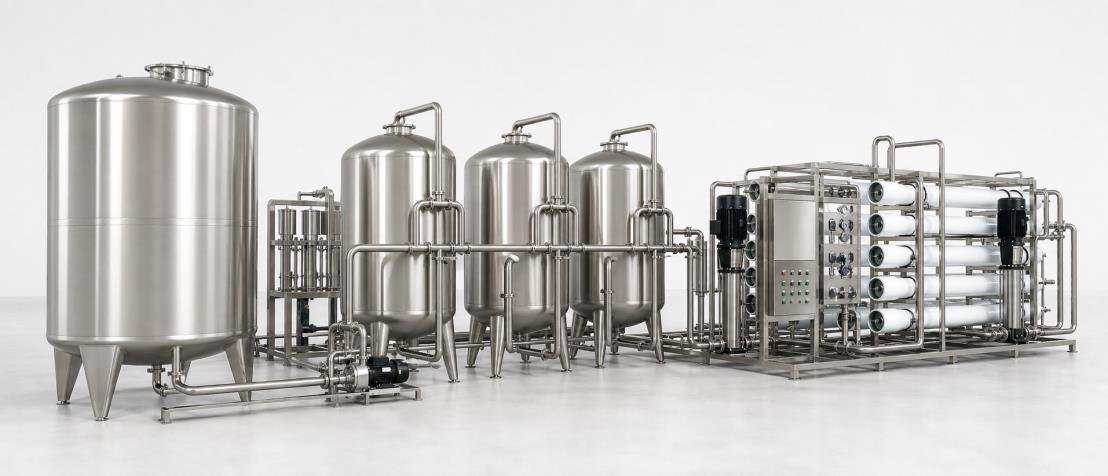
A bottled-water treatment system may include raw-water storage, pretreatment, membrane separation where required, disinfection, treated-water storage and final transfer. Not every project needs every stage. The final route is selected from raw-water analysis, the product-water target, capacity, recovery requirements and local project conditions.
System focus 01
Multi-medium filtration, activated carbon, softening or ion exchange, precision filtration, RO, ultrafiltration, UV and ozone are equipment options. Their order and inclusion require process review.
System focus 02
The treatment system must account for filler demand, operating hours, recovery, cleaning and storage. A nominal feed rate alone does not define the available product-water flow.
System focus 03
Water quality can be lost through unsuitable tanks, piping or stagnant transfer. The scope should define materials, sanitary details, instrumentation and the conditions expected at the filler inlet.
Treatment selection sequence
The route should be built from project evidence rather than a universal equipment train.
Collect representative physical, chemical and microbiological data with source and seasonal context.
State the intended water definition and obtain the project-specific regulatory review.
Choose pretreatment, separation and disinfection steps from the evidence and operating duty.
Account for recovery, production demand, sanitation, storage turnover and concentrate handling.
Define storage, piping, monitoring, cleaning and the required conditions at the filler inlet.
Buyer questions
Use these answers as a project-planning starting point. Final equipment and performance remain subject to the confirmed brief.
There is no universal equipment train. Storage, filtration, membrane, disinfection and polishing options are selected only after the source-water data and product target are understood.
Use the required usable product-water flow, production and cleaning demand, operating hours, recovery, reject streams, storage and filler-feed conditions rather than feed-pump rating alone.
Unsuitable storage, stagnant sections or poorly defined transfer can compromise treated-water quality. The hygienic path must continue to the filler inlet.
Deep technical guides
Each guide answers one narrower project question and links the result back to complete-line scope.
A laboratory report becomes an engineering input only when the sample source, date, method, operating context and intended bottled-water product are also understood.
A bottled-water ozone system must deliver a validated treatment under defined water conditions while controlling residuals, off-gas and worker exposure.
A reverse osmosis proposal becomes comparable only when feed-water variation, finished-water targets, net production demand and every supporting utility are stated on the same basis.
The product-water tank and filler-feed loop are active process interfaces, not passive capacity: their design influences turnover, pressure stability, cleaning access and restart behavior.
A borehole can provide a consistent-looking supply while still varying in yield, chemistry, particulates or microbiological condition, so the design basis must connect source evidence to the intended product.
High total dissolved solids describes a concentration, but process selection depends on which ions are present, how they vary and what finished-water composition is permitted and intended.
Iron and manganese results become actionable only when sampling preserves their actual dissolved, colloidal or particulate condition and the proposed treatment is tested against the source-water envelope.
RO recovery determines how feed water divides between permeate and concentrate, but a higher percentage is useful only when chemistry, hydraulics, product quality and the residual route remain acceptable.
UV and ozone act differently and can serve different points in a bottled-water system; selection begins with the target organism, water condition and required protection zone.
A sanitation recipe becomes defensible when equipment coverage, operating parameters, chemical preparation, rinse completion and release evidence are all traceable.
Product output is only one branch of plant water use; treatment reject, backwash, rinsing, cleaning and drains must be visible on the same boundary.
Sanitary material alone does not make a hygienic piping system when the route retains water, hides branches or cannot be verified after installation.
Activated carbon is selected for a defined adsorption or dechlorination duty, not simply because it appears in a standard treatment train. Source-water organics, disinfectant exposure, downstream membranes, microbial risk and required run length determine media, contactor and monitoring decisions.
A multimedia filter protects downstream treatment by reducing a characterized particulate and turbidity load. Media grading, bed depth, filtration rate, coagulation strategy where used and backwash capability must match the source variability and downstream tolerance.
Ultrafiltration can provide a defined particulate and microbial barrier, but membrane type, pretreatment, flux and cleaning strategy must follow source-water challenge and downstream duty. It is not automatically superior to a well-designed conventional pretreatment system.
pH and alkalinity adjustment should stabilize a defined bottled-water product without treating one pH reading as proof of composition or safety. The selected acid, base, carbon dioxide, mineral contact or blending method must account for buffering, mixing and downstream packaging.
A microbiological barrier train combines source protection, treatment, disinfection, hygienic storage and controlled filling so no single unverified step carries the complete risk. Each barrier needs a defined hazard, operating envelope and verification method.
Capacities, process routes, layouts, utilities and equipment shown on this site are decision frameworks and reference examples. They are not a final specification, performance guarantee or offer. Confirmed scope and performance are defined in the signed technical and commercial agreement.
Allot Tech project desk
Share the source water, bottle, target output, pack format, factory status and destination. We will use them as the basis for a project-specific configuration discussion.