Treat the ionic profile, not one conductivity number
High-TDS Water Treatment for Bottled Water
High total dissolved solids describes a concentration, but process selection depends on which ions are present, how they vary and what finished-water composition is permitted and intended.
How should high-TDS water be treated for bottled-water production?
Obtain a charge-balanced ionic analysis with representative ranges, temperature, pH and supporting scaling and fouling indicators. Define the intended product-water specification and jurisdiction-specific product category before deciding how much dissolved material should be removed or retained. A membrane route may be appropriate, but its pretreatment, pressure, recovery, energy, cleaning and concentrate duties must be calculated from the actual feed. Product conditioning or controlled blending may also require review, monitoring and legal confirmation. Compare proposals on net compliant product water, complete mass balance, operating limits and residual management rather than a generic salt-rejection percentage.
System focus 01
Characterize ions, variability and the intended product
Conductivity or TDS alone cannot show whether calcium carbonate, sulfate, silica or another constituent will constrain recovery, nor does it establish taste or legal product composition. Request major cations and anions, alkalinity, hardness, silica, relevant trace constituents, pH and temperature on representative samples. Check the ionic balance and laboratory units before using the data in a design model. Then state the desired product-water range, treatment claims and destination markets for qualified review. Keep naturally derived constituents, intentionally added minerals and blended streams traceable rather than using an undefined final TDS target.
Major cations, anions, alkalinity, hardness and silica
Conductivity, calculated or measured TDS and temperature context
Sampling variation and data-quality or ionic-balance review
Finished-water composition and local product-category basis
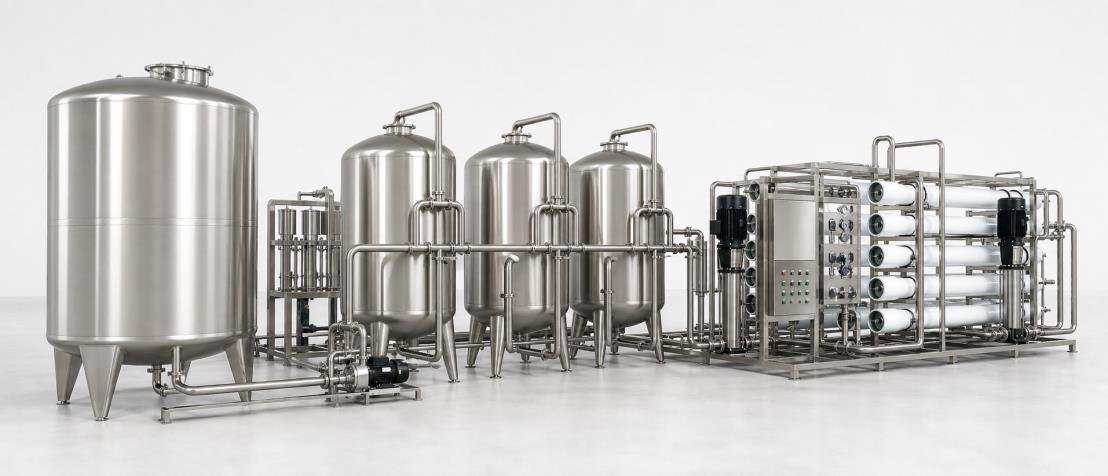
Reference equipment image. The final equipment selection, configuration and safeguards depend on the confirmed project brief.
System focus 02
Design pretreatment around scaling and fouling mechanisms
High dissolved solids can increase scaling potential, but the required pretreatment depends on the ionic combination, concentration factor and membrane selection. Suspended solids, organics, iron, manganese, oxidants and biological activity may create separate risks. Ask the process designer to show the purpose and limits of filtration, softening, dosing, pH adjustment or other proposed stages. Chemical selection should include compatibility, storage, dosing control, safe handling and residual implications. A generic cartridge filter does not replace a complete pretreatment assessment, and an antiscalant name does not prove that every recovery scenario is acceptable.
Scaling calculation tied to proposed recovery and temperature
Particulate, organic, metal and biological fouling review
Pretreatment purpose, outlet criterion and monitoring point
Chemical compatibility, dosing, storage and safety boundary
System focus 03
Compare membrane designs on net flow and operating envelope
Request the selected membrane type, array, design flux, permeate and concentrate flows, recovery, predicted pressure, temperature basis and product quality over the agreed feed range. Predictions are engineering models whose assumptions should remain attached to the quotation. Review pump, energy-recovery or staging concepts where relevant, plus flush, preservation and cleaning provisions. The declared product flow should be measured at a named point and should not conceal internal recycle or auxiliary use. Consider how membrane aging, cleaning and feed variation are managed operationally without turning a conservative allowance into an unsupported lifetime guarantee.
Membrane model, array and calculation revision
Feed range, temperature, flux, pressure and recovery basis
Permeate, concentrate, recycle and auxiliary-flow balance
Flush, preservation, cleaning and operating-limit strategy
System focus 04
Define product conditioning and storage as controlled processes
Very low-mineral permeate may require project-specific conditioning for the intended product, equipment compatibility or sensory objective. Options can include controlled blending or addition through a validated process, but the permitted approach and final description must be reviewed locally. Specify ingredient or blend-water identity, dosing control, interlocks, monitoring and traceability. The final water then enters a hygienic storage and filler-feed system with defined turnover and cleaning. Conductivity can support control but may not uniquely identify every constituent, so the release plan should retain appropriate laboratory checks and controlled formulations.
Target finished-water composition and permitted process review
Blend or ingredient identity, control and traceability
Final monitoring separated from formula assumptions
Storage turnover, recirculation and filler-feed boundary
System focus 05
Plan concentrate management and performance evidence early
A high-TDS feed produces a more concentrated residual stream whose volume and composition follow the complete mass balance. Identify possible discharge, reuse or further-treatment routes only after site water demand, materials, soil or sewer constraints and local permission are reviewed. Reuse in cooling, cleaning or another service can transfer salts or chemicals into equipment and wastewater, so compatibility and accumulation need evaluation. Acceptance should record feed composition, temperature, flows, pressures, conductivity and relevant product results after stabilization. Ongoing trends should trigger investigation before operation moves outside the declared design envelope.
Concentrate flow and composition at agreed operating cases
Site-specific reuse, treatment or discharge assessment
Commissioning stabilization, sampling and instrument accuracy
Operating trends, alarm limits and corrective-action ownership
High-TDS proposal matrix
Compare treatment offers on one mass-balance basis
Require each supplier to state the feed case, net product result and residual boundary behind the proposed equipment.
Decision area
Confirmed input
Supplier return
Review question
Feed chemistry
Ionic analysis, ranges and temperature
Design envelope and missing-data list
Are scaling species and variation represented?
Product objective
Composition, category and destination review
Permeate and conditioning basis
Is the final water, not only membrane output, defined?
Pretreatment
Fouling risks and site chemical constraints
Stage purpose, dose and monitoring
Does each stage address a documented mechanism?
Membrane duty
Net demand and operating schedule
Array, recovery, pressure, flows and utilities
Are assumptions and recycle streams visible?
Residual route
Site services and local review boundary
Concentrate quantity, quality and tie-in
Can the proposed route receive this stream?
Acceptance
Sampling and instrument requirements
Test method, stabilization and records
Will evidence reflect the declared feed condition?
Treatment and product decisions remain conditional on confirmed chemistry, local requirements, selected equipment and the approved residual-management route.
Buyer questions
Frequently asked questions
Use these answers as a project-planning starting point. Final equipment and performance remain subject to the confirmed brief.
What TDS value requires reverse osmosis for bottled water?
There is no universal threshold. The ionic composition, product target, local category rules, sensory objective, treatment alternatives, residual route and economics all matter. Use a complete analysis and project-specific process review.
Does high membrane salt rejection guarantee the finished-water specification?
No. Actual permeate depends on feed composition, temperature, pressure, recovery, membrane condition and the complete process. Product conditioning, storage and sampling also affect the finished-water evidence.
Can RO concentrate be reused inside the plant?
Potential uses require a site-specific water-quality, material, health, wastewater and regulatory review. Reuse can concentrate salts or treatment chemicals elsewhere, so it should not be assumed from flow volume alone.
Can conductivity replace laboratory ion testing?
Conductivity is a useful trend and control signal, but different ionic mixtures can produce similar readings. Laboratory analysis remains necessary where individual constituents, source changes or product specifications must be confirmed.
Continue planning
Related production-line decisions
Move to the technical decision that depends on the information covered on this page.
Keep hydraulic load and residual composition visible for local assessment.
Project-specific confirmation
Capacities, process routes, layouts, utilities and equipment shown on this site are decision frameworks and reference examples. They are not a final specification, performance guarantee or offer. Confirmed scope and performance are defined in the signed technical and commercial agreement.
Allot Tech project desk
Turn your requirements into a comparable line brief.
Share the source water, bottle, target output, pack format, factory status and destination. We will use them as the basis for a project-specific configuration discussion.