What must be confirmed before selecting a PET blower?
Confirm the bottle and preform drawings, neck finish, resin and weight basis, required formats, target output, mold scope, changeovers and available utilities.
Bottle preparation stream
The blower must supply stable bottles at the required rate and hand them to the filler without creating the first bottleneck.
Direct answer
A PET bottle blowing system heats approved preforms, forms bottles in project-specific molds and transfers them toward rinsing and filling. Its usable output depends on the bottle design, preform, cavity configuration, air system, cooling and changeover requirements. The blower, air conveyor and filler must be reviewed as one connected bottle stream.
System focus 01
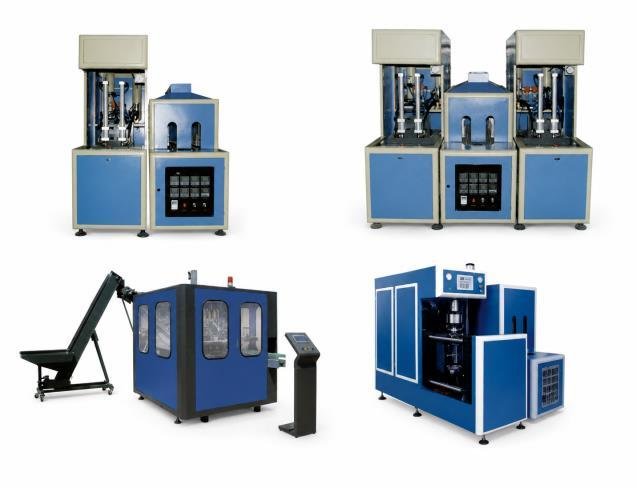
A production-line quotation needs the bottle drawing, volume, neck finish, cap and expected material. A reference bottle cannot be assumed to represent every format.
System focus 02
The compressor, air treatment, receivers and cooling provisions must match the blower and site conditions. Omitting them from a quotation creates an incomplete bottle-production scope.
System focus 03
Newly formed bottles must remain stable through discharge and air conveying. Transfer geometry, speed control and accumulation influence scratches, deformation, tipping and filler starvation.
Blower interface register
A blower cannot be selected independently from its preform, mold, air system and filler connection.
| Interface | Required project input | Acceptance focus |
|---|---|---|
| Preform and bottle | Approved drawings, resin/preform basis, neck, weight and formats | Stable bottle geometry and agreed quality checks |
| Mold and change parts | Format list, mold scope and changeover responsibilities | Complete tooling and repeatable format setup |
| Compressed air | Pressure, quality, normal/peak flow, treatment and storage | Stable supply under the agreed operating test |
| Cooling and environment | Water conditions, ambient range, ventilation and heat rejection | Repeatable process conditions |
| Bottle discharge | Rate, neck handling, air conveyor, controls and buffer strategy | Stable transfer without damage or filler starvation |
Buyer questions
Use these answers as a project-planning starting point. Final equipment and performance remain subject to the confirmed brief.
Confirm the bottle and preform drawings, neck finish, resin and weight basis, required formats, target output, mold scope, changeovers and available utilities.
Blowing depends on correctly sized compression, air treatment, storage and cooling. Leaving these systems outside the review can create an incomplete or under-sized bottle stream.
Compare both machines on the same bottle and operating basis, then review rejects, changeovers, transfer behavior and useful accumulation between them.
Deep technical guides
Each guide answers one narrower project question and links the result back to complete-line scope.
Preform weight, neck finish and bottle geometry must work together with the blow mold, closure, air conveyor, filler and capper.
Stable mold and equipment cooling supports bottle release and repeatability throughout a production run, while an underspecified loop can become a hidden line constraint.
Preforms and empty bottles place cost, space, quality control and operating responsibility in different parts of the supply chain, so the better route depends on local project conditions.
An unscrambler must do more than stand bottles upright: it must supply the downstream conveyor without damage, contamination risk, repeated jams or uncontrolled surges.
A 330ml or 500ml format can drive high bottle counts, frequent material replenishment and sensitive lightweight-container handling even when packaged-water volume is moderate.
One-liter and 1.5-liter bottles can carry substantial water volume while creating different stability, transfer and packing demands from a high-count small-bottle line.
Three-liter and 5-liter PET bottles combine high filled mass with format-specific neck, handle, base and pack choices that change every transfer from blowing or bottle supply to pallet handling.
Cloudiness, pearlescence, uneven walls, weak bases, distorted necks and unstable bottle transfer can share visible symptoms while arising from very different material, heating, air, mold, cooling or handling conditions.
A PET blower can only deliver stable bottles when the compression, air treatment, receivers, cooling and distribution system sustain its real operating demand.
Moving between 500ml, 1L and 1.5L bottles can affect bottle handling, filler settings, caps, labels, inspection recipes and pack patterns across the whole line. The supported formats and required change parts must still be confirmed for the selected equipment.
Conveyors are a dynamic interface system: they must move empty and filled bottles without instability, damage, contamination risk or repeated starvation and blocking.
PET bottle molds and line change parts must preserve the approved bottle geometry from blowing through filling, labeling and packing. Mold design, cooling, venting and stretch conditions interact with downstream neck, body and base handling.
Capacities, process routes, layouts, utilities and equipment shown on this site are decision frameworks and reference examples. They are not a final specification, performance guarantee or offer. Confirmed scope and performance are defined in the signed technical and commercial agreement.
Allot Tech project desk
Share the source water, bottle, target output, pack format, factory status and destination. We will use them as the basis for a project-specific configuration discussion.