Turn bulk empty bottles into a controlled single-file supply
PET Bottle Unscrambler for a Water Bottling Line
An unscrambler must do more than stand bottles upright: it must supply the downstream conveyor without damage, contamination risk, repeated jams or uncontrolled surges.
How should a PET bottle unscrambler be selected for a water bottling line?
Give suppliers the actual empty-bottle drawings, samples, format range, required orientation, target line states and filler-infeed interface. Define how bottles arrive in bulk, who loads them, the acceptable buffer, the discharge elevation and the control handshake with the conveyor or filler. Ask which format parts and adjustments are required, how incorrect or damaged bottles are handled, and how operators reach every likely jam point. Acceptance should use representative bottles through loading, start-stop operation, starvation, blocking, recovery and format change. A quoted maximum speed without those boundary conditions does not establish dependable line supply.
System focus 01
Qualify every bottle before fixing the handling concept
Empty PET bottles are light, easily marked and sensitive to shape. Provide controlled drawings and physical samples for each intended format, including the neck finish, height, maximum body diameter, base geometry, mass and any panels, grips or asymmetry. State whether bottles can be nested, distorted, dusty or statically charged when delivered. Also identify artwork or surface areas that must not be scuffed. The supplier should classify which formats share one setup, which need change parts and which fall outside the machine envelope. Bottle qualification reduces the risk of buying an unscrambler around a single convenient sample.
Controlled bottle drawing and approved physical samples
Neck finish, height, body diameter, base and mass range
Asymmetry, grip, panel and surface-protection requirements
Expected bottle condition at bulk-machine loading
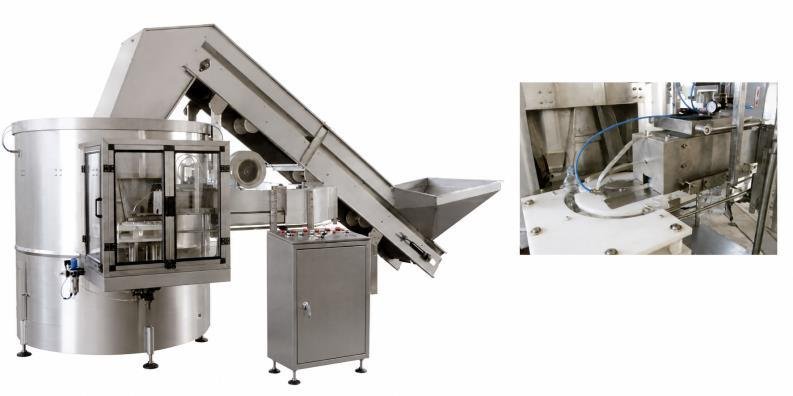
Reference equipment image. The final equipment selection, configuration and safeguards depend on the confirmed project brief.
System focus 02
Design bulk loading around storage, labor and contamination control
Define whether bottles arrive in bags, bins, cartons or another transfer unit and where packaging is removed. The loading concept may include a floor-level hopper, elevated hopper, belt elevator or container tipper, but each option changes operator effort, footprint, guarding and bottle exposure. Calculate practical replenishment intervals from usable hopper capacity and demand, not geometric volume. Review how foreign material is prevented from entering, how spilled bottles are contained and how empty packaging leaves the area. Safe access for clearing the hopper and cleaning the loading route must be resolved before layout approval.
Incoming bulk packaging and unpacking responsibility
Usable hopper buffer and replenishment interval
Operator lifting, platform, tipper and guarding arrangement
Foreign-material, spillage and empty-packaging control
System focus 03
Match orientation and discharge to the downstream handover
The internal mechanism must separate, orient and present bottles without crushing sidewalls, trapping necks or creating uncontrolled contact. Confirm whether discharge is by neck support, base support or another method and whether the downstream route uses air conveying or a tabletop conveyor. Fix the elevation, centerline, direction, bottle pitch and acceptable queue condition at the handover. If the filler needs a particular orientation, that requirement must survive the complete route. The interface schedule should include guides, transition parts, fans where applicable, sensors and the party responsible for the connecting conveyor section.
Orientation requirement and treatment of incorrectly presented bottles
Discharge support method, elevation, direction and centerline
Transfer geometry, guide profile and bottle pitch
Responsibility for connecting conveyor, sensors and supports
System focus 04
Use line-state controls to prevent starvation and bottle surges
A good unscrambler responds smoothly to the downstream line instead of repeatedly starting at full output and stopping against a packed conveyor. Define ready, run, blocked, starved, low-bottle and fault signals, plus speed reference or staged output if available. Sensor positions and delays should account for the usable bottle buffer between machines. The control narrative must cover restart after a jam, loss of air or power, guard opening and manual operation during maintenance. Ask how alarms identify the affected zone and how retained bottles are handled when the line is stopped for an extended period.
Run permission, blocked and low-bottle signal exchange
Output modulation and downstream buffer-level logic
Jam, guard, air-loss and power-recovery sequence
Alarm location, retained-bottle and manual-mode handling
System focus 05
Verify changeover, access and recovery with real bottles
Request a format matrix listing every tool, change part, recipe and adjustment. Operators should be able to inspect bottle-contact zones, remove fallen containers and clean dust or fragments without unsafe reach or excessive dismantling. Maintenance review should include wear parts, lubrication points, drives, belts, sensors and access to elevated items. During factory or site testing, run agreed samples in sufficient quantity to observe stable feeding, then introduce normal line events: hopper replenishment, controlled blocking, starvation, stop and restart. Record damage, misorientation, jams and recovery actions instead of accepting only a short uninterrupted speed demonstration.
Format matrix with settings, parts, tools and reference samples
Safe access to bottle paths and common jam locations
Wear-part, lubrication and preventive-maintenance schedule
Event-based acceptance record using representative bottles
Unscrambler selection matrix
Tie the machine offer to bottle and line evidence
Compare suppliers on the inputs and operating events that determine usable empty-bottle supply.
Review area
Required input
Supplier response
Verification evidence
Bottle family
Drawings, samples and expected condition
Format envelope, exclusions and change parts
Approved sample list and run record
Bulk loading
Packaging, replenishment and labor method
Hopper, elevator, tipper and guarding scope
Loading demonstration and usable buffer
Orientation
Required bottle presentation and surface limits
Handling principle and wrong-bottle response
Orientation and damage observations
Discharge interface
Elevation, direction, support and downstream equipment
Transition, guide, sensor and scope drawing
Dimensional and dynamic handover check
Controls
Line states and available accumulation
Signal list, modulation and recovery logic
Blocked, starved, fault and restart challenge
Ownership
Cleaning, access and maintenance expectations
Procedures, parts list and service clearances
Changeover and maintenance demonstration
Any capacity statement should identify the accepted bottle formats, bulk-loading condition, downstream interface and test method.
Buyer questions
Frequently asked questions
Use these answers as a project-planning starting point. Final equipment and performance remain subject to the confirmed brief.
Is an unscrambler needed when bottles are blown in the same plant?
Often not for a directly connected blower-to-filler route, because newly blown bottles can transfer in single file. It may still be relevant if bottles are accumulated in bulk, supplied from another area or require a different production arrangement. Confirm the complete empty-bottle flow first.
Can one bottle unscrambler handle all PET bottle shapes?
No universal claim is reliable. Handling depends on neck, height, diameter, base, mass, stiffness, asymmetry and surface condition. Each format should be reviewed and preferably tested; the supplier should declare adjustments, change parts and excluded geometries.
How much bottle buffer should the hopper provide?
Choose buffer time from line demand, replenishment method, operator travel, available space and the acceptable risk of starving the filler. Use usable bottle capacity demonstrated with representative containers rather than the empty geometric hopper volume.
What should be checked during unscrambler acceptance?
Check representative formats, safe loading, correct orientation, bottle condition, discharge interface, start-stop behavior, blocked and starved responses, jam recovery, alarms, format change and access. Agree the test duration and bottle supply before the test.
Continue planning
Related production-line decisions
Move to the technical decision that depends on the information covered on this page.
Use approved bottles and agreed stop, start and recovery scenarios.
Project-specific confirmation
Capacities, process routes, layouts, utilities and equipment shown on this site are decision frameworks and reference examples. They are not a final specification, performance guarantee or offer. Confirmed scope and performance are defined in the signed technical and commercial agreement.
Allot Tech project desk
Turn your requirements into a comparable line brief.
Share the source water, bottle, target output, pack format, factory status and destination. We will use them as the basis for a project-specific configuration discussion.