Define the treatment duty before selecting an RO skid
Reverse Osmosis System for Bottled Water Production
A reverse osmosis proposal becomes comparable only when feed-water variation, finished-water targets, net production demand and every supporting utility are stated on the same basis.
How should a reverse osmosis system be selected for bottled water production?
Begin with representative raw-water analysis and the approved product-water specification, then calculate the net treated-water demand from filler consumption, operating hours, sanitation use, losses and storage strategy. Ask each supplier to state pretreatment assumptions, membrane duty, design recovery, permeate flow at declared feed conditions, reject-water route, clean-in-place boundary, instruments, consumables and utility loads. The selected system must also connect reliably to hygienic storage and the filler feed. Acceptance should therefore compare defined water-quality measurements and stable net flow at agreed conditions, not a pump nameplate or an unqualified membrane rating.
System focus 01
Use representative source-water data as the design input
One laboratory result is not automatically a design envelope. Collect samples that represent relevant seasons, wells, municipal supply changes or blending arrangements, and record sampling location and date. The analysis should cover the parameters needed to evaluate scaling, fouling, oxidation, membrane compatibility and product treatment objectives. Where a value varies, give bidders a range rather than a convenient average. Suppliers should identify any missing test that prevents final selection and should distinguish assumed values from confirmed data. This makes pretreatment choices and operating limits traceable instead of hiding them inside a generic RO package.
Source, sampling point, date and expected seasonal variation
Dissolved solids, hardness, alkalinity, silica and relevant ions
Turbidity, suspended matter, iron, manganese and organic indicators
Temperature, pH, disinfectant residual and microbiological context
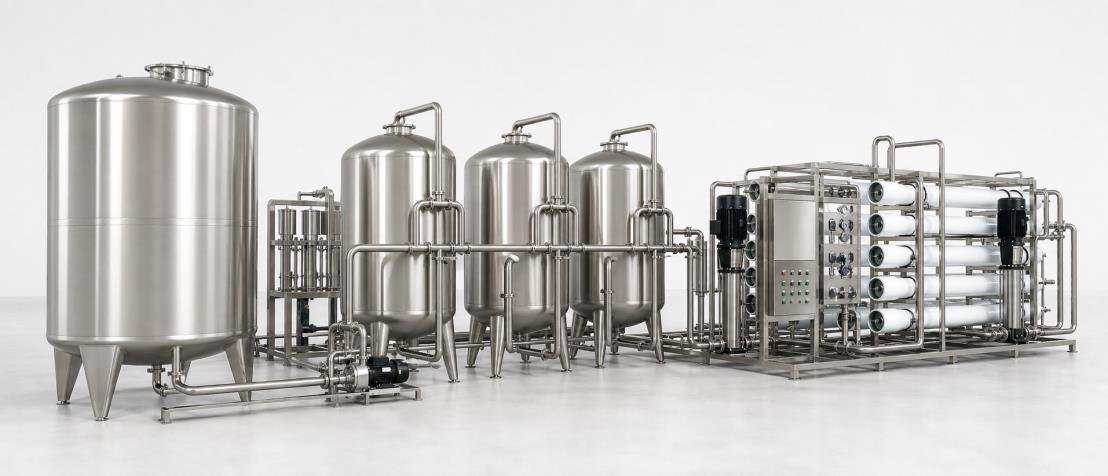
Reference equipment image. The final equipment selection, configuration and safeguards depend on the confirmed project brief.
System focus 02
Size net permeate production around the factory schedule
The filler bottle-per-hour rating does not directly equal the RO flow. Convert the product plan into water volume by bottle format, realistic scheduled hours and the expected operating pattern. Add defined water users such as product change, start-up flushing or an agreed sanitation demand, while keeping unrelated factory consumption outside the product-water duty. Storage can decouple treatment and filling for a limited period, but it does not create daily capacity. Ask for a balance showing gross feed, permeate, reject and auxiliary streams at stated feed temperature and composition so each quotation uses the same net-output basis.
Bottle mix, scheduled filler hours and net packaged-water demand
Defined process-water users outside saleable bottle volume
Permeate flow, recovery and availability stated separately
Storage operating window and refill strategy during production
System focus 03
Review pretreatment, membrane protection and cleaning as one train
Pretreatment must respond to the actual feed-water risks and the selected membrane limits. A process may include oxidation control, clarification or filtration, hardness or scale control, cartridge protection and chemical dosing, but the correct sequence is project-specific. Request the basis for each stage, expected inlet and outlet condition, monitoring point, consumable and disposal stream. The proposal should define how membranes are isolated, flushed and cleaned, what cleaning equipment is included, and which chemicals remain the buyer's responsibility. Maintenance access for filters, pressure vessels, valves and sampling points belongs in the equipment review.
Treatment purpose and design basis for every upstream stage
Chemical compatibility, dosing control and safe replenishment boundary
Differential-pressure, conductivity, flow and pressure monitoring points
Flush, preservation and membrane-cleaning equipment responsibility
System focus 04
Engineer the permeate handover to storage and filling
Permeate quality can change after the membrane if storage, vents, piping or stagnant branches are poorly integrated. Define the RO outlet connection, tank inlet arrangement, recirculation concept, final treatment if specified, filler-feed pressure and the operating response when either the RO or filler stops. Materials, drainability, sampling access and cleaning boundaries should be reviewed for the product-water zone. Control signals must prevent the RO from cycling on every small level change while also protecting pumps and preventing tank overflow. The interface schedule should assign the tank, pumps, instruments, valves, cables and interconnecting pipework to named supply scopes.
Permeate outlet quality and hydraulic handover point
Tank level band, RO start-stop logic and overflow response
Filler-feed pressure, peak demand and minimum suction condition
Recirculation, final-treatment and hygienic piping boundaries
System focus 05
Write acceptance around declared conditions and usable evidence
A useful request for quotation asks for a process description, flow balance, equipment list, instrument list, utility schedule, consumables, exclusions and recommended maintenance items. Factory testing can verify assembly, controls, alarms and simulated operating sequences, while water-performance evidence may require suitable feed water and calibrated measurements at site. Agree the sampling method, stabilization period, instrument accuracy and treatment conditions before testing. Record permeate and reject flows together with relevant quality readings and feed conditions. Final acceptance should not imply that one short test proves every seasonal source-water condition unless that range was specifically represented and agreed.
Issued process flow, piping boundaries and control narrative
Agreed test feed condition, stabilization period and sampling method
Calibrated flow, pressure and quality evidence at named points
Handover of operating limits, consumables and maintenance instructions
RO inquiry comparison matrix
Make every bidder state the same design basis
Use this matrix to expose assumptions before comparing skid size, membrane count or commercial scope.
Decision input
Buyer should provide
Supplier should return
Acceptance boundary
Feed-water envelope
Representative analysis, variation and sampling context
Missing-data list and declared design range
Test conditions recorded with results
Product duty
Target specification, net demand and operating schedule
Permeate flow and quality basis at stated conditions
Named outlet point and measurement method
Pretreatment
Available upstream processes and chemical constraints
Purpose, sizing basis, monitoring and residual risk
Stage checks against agreed inlet conditions
Membrane train
Required availability and operating philosophy
Array, recovery, operating limits and protection logic
Stable operation within declared feed envelope
Cleaning and consumables
Site safety rules, storage and disposal constraints
Included equipment, initial supply and replacement schedule
Functional sequence and handover records
Storage and filler feed
Tank concept, filler demand and interface locations
Hydraulic, signal and responsibility schedule
Integrated site trial with representative demand
Final configuration and acceptance values remain subject to confirmed source water, product requirements, equipment selections and project-specific test conditions.
Buyer questions
Frequently asked questions
Use these answers as a project-planning starting point. Final equipment and performance remain subject to the confirmed brief.
Can an RO system be selected from total dissolved solids alone?
No. Total dissolved solids is useful but does not describe all scaling, fouling, oxidation or pretreatment risks. A selection should consider a representative analysis, variation over time, temperature, target product specification, flow duty and the selected membrane supplier's operating limits.
Is the rated permeate flow the same as water available to the filler?
Not necessarily. Net water available depends on stated feed conditions, membrane condition, treatment availability, flushing or sanitation consumption, storage level and the filler schedule. Ask for a complete water balance and define the measurement point used for acceptance.
Should every bottled water plant use the same RO recovery?
No. Recovery is constrained by feed-water composition, pretreatment, membrane arrangement, concentrate management and the operating strategy. A higher stated recovery can increase concentration and scaling risk, so it should be justified by a calculation rather than treated as a universal target.
What should be included in the RO cleaning scope?
Clarify the cleaning tank, pump, heater if required, filters, hoses or fixed piping, chemical mixing, isolation, drain route, procedures, safety controls and initial consumables. The final method and chemistry must follow the confirmed membrane, deposit risk and site safety review.
Continue planning
Related production-line decisions
Move to the technical decision that depends on the information covered on this page.
Water softening upstream of RO is justified by hardness loading, membrane recovery, scaling calculations and the complete pretreatment strategy. Resin capacity, vessel duty, brine system and regeneration controls must support the actual production and reject-water plan.
RO antiscalant selection begins with a complete feed-water analysis, recovery and concentrate chemistry. The chemical, dose and control strategy must be compatible with membranes, pretreatment and the approved product route, and cannot be chosen from a generic dose range.
RO cleaning should respond to normalized evidence of fouling or scaling and use a membrane-compatible procedure matched to the likely deposit. Cleaning too late can make recovery difficult, while unnecessary cleaning adds chemical exposure and downtime.
Project-specific confirmation
Capacities, process routes, layouts, utilities and equipment shown on this site are decision frameworks and reference examples. They are not a final specification, performance guarantee or offer. Confirmed scope and performance are defined in the signed technical and commercial agreement.
Allot Tech project desk
Turn your requirements into a comparable line brief.
Share the source water, bottle, target output, pack format, factory status and destination. We will use them as the basis for a project-specific configuration discussion.