RO recovery determines how feed water divides between permeate and concentrate, but a higher percentage is useful only when chemistry, hydraulics, product quality and the residual route remain acceptable.
How should RO recovery and reject water be planned for a bottled-water plant?
Define recovery as permeate flow divided by membrane feed flow for a named operating case, then keep any recycle and auxiliary streams visible. Use representative ionic chemistry, temperature, pretreatment and membrane data to model concentration, scaling, pressure and permeate quality at the proposed recovery. Convert the result into daily net product water, feed demand, concentrate and cleaning or flushing streams across the production schedule. Evaluate reuse, treatment or discharge only against the actual concentrate composition and local site requirements. Accept the system from measured flows and water results under recorded conditions, not from a control-screen percentage without reconciled meters.
System focus 01
Use one recovery definition and draw every stream
Start with a process flow that labels raw feed, pretreated feed, membrane feed, permeate, concentrate, recycle, flush, sample and cleaning streams. Recovery may be quoted at membrane, stage, skid or whole-treatment level, producing different numbers if boundaries are unclear. State the calculation point and time basis for every flow. A basic membrane balance is feed equals permeate plus concentrate where no other stream crosses that boundary, while the plant balance also includes pretreatment losses and auxiliary consumption. Reconcile both instantaneous flows and daily volumes so a favorable skid percentage does not conceal insufficient net water.
Named membrane, skid and complete-plant boundaries
Feed, permeate, concentrate, recycle and auxiliary streams
Instantaneous flow and scheduled daily-volume basis
Net product-water point available to storage and filling
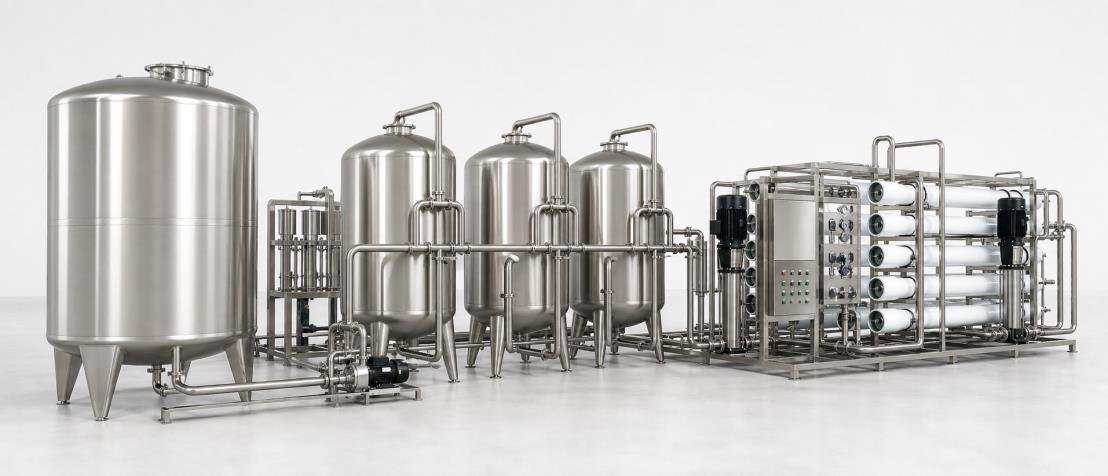
Reference equipment image. The final equipment selection, configuration and safeguards depend on the confirmed project brief.
System focus 02
Set recovery limits from feed chemistry and membrane design
As recovery rises, retained constituents become more concentrated along the membrane train. The acceptable limit depends on ionic composition, pH, temperature, pretreatment, flux, array, membrane selection and cleaning strategy. Ask for the calculation file or report revision, feed cases, saturation or scaling assessment, pressure prediction and product-quality result. Examine minimum and maximum feed temperatures and relevant source variation rather than only a favorable nominal case. Chemical dosing can support a justified design but should not be used to erase uncertainty about feed composition or residual handling.
Representative ionic analysis and design feed cases
Membrane array, flux, pressure and temperature basis
Concentration, scaling and permeate-quality predictions
Pretreatment, dosing and cleaning operating limits
System focus 03
Compare recovery with net output, energy and availability
A project decision should compare more than feed-water saving. Review net permeate produced, pump duty, pretreatment consumption, cleaning frequency expectations, membrane protection, control complexity and the consequence of an unavailable train. Storage and operating schedule affect whether a smaller or intermittent treatment system can meet filler demand. Build base, difficult-feed and low-demand cases without claiming future performance that has not been represented. The selected design should make assumptions explicit and leave margin decisions traceable to the buyer rather than hiding them inside an unexplained nominal recovery.
Net permeate demand by production and sanitation schedule
Pump and pretreatment loads at each modeled case
Availability, train isolation and storage operating strategy
Declared design allowance and condition-specific limitations
System focus 04
Evaluate concentrate as water with a changed composition
Reject water contains feed constituents at higher concentration and may also reflect treatment chemicals. Measure or predict its flow and composition for each operating case before proposing a route. Potential reuse for non-product purposes needs compatibility, accumulation, aerosol, cleaning, wastewater and local regulatory review. Further treatment can create another concentrate or solid residual and additional utilities. A sewer, surface, infiltration or off-site route must not be assumed from a generic design. Assign sampling, pipework, storage if any, overflow protection and final permission to named scopes.
Concentrate quantity and composition by recovery case
Treatment-chemical contribution and variability
Reuse compatibility and salt-accumulation assessment
Local discharge review, tie-in and responsibility owner
System focus 05
Meter, trend and accept the installed water balance
Specify calibrated or verified flow measurement at the points needed to reconcile feed, permeate, concentrate and important recycle streams. Trend pressure, temperature and conductivity with flows so apparent recovery changes can be investigated. Define stabilization time, sampling method and treatment state for acceptance, then compare results with the declared feed envelope and calculation basis. Meter uncertainty and asynchronous readings can create an impossible balance, so timestamps and instrument accuracy matter. Handover should include alarm limits, cleaning triggers, concentrate response and the rule for operating outside the modeled water condition.
Flow-meter locations, ranges, accuracy and timestamps
Pressure, temperature, conductivity and quality trends
Stabilization, sampling and acceptance calculation method
Alarm, investigation and out-of-envelope operating response
RO recovery decision matrix
Compare recovery cases without hiding boundary streams
Build one row for each credible operating case and retain the source calculation and residual assumption.
Case input
What changes
Evidence to review
Decision boundary
Feed chemistry
Scaling and product-quality risk
Representative ions and calculation revision
Confirmed source-water envelope
Feed temperature
Flux, pressure and membrane behavior
Minimum, normal and maximum modeled cases
Seasonal and process operating range
Recovery target
Permeate and concentrate flow
Complete mass balance with recycle visible
Net plant water, not isolated skid ratio
Pretreatment
Fouling control, chemicals and residuals
Stage performance and operating limits
Available monitoring and maintenance capability
Concentrate route
Reuse, discharge or further treatment duty
Composition, hydraulic peak and local review
Approved site tie-in and owner
Acceptance
Measured water balance and quality
Synchronized meters, samples and conditions
Declared case represented during test
Recovery is an operating result within a defined feed, membrane, pretreatment and residual-management envelope, not a context-free performance promise.
Buyer questions
Frequently asked questions
Use these answers as a project-planning starting point. Final equipment and performance remain subject to the confirmed brief.
Is higher RO recovery always better for a bottling plant?
No. Higher recovery can reduce concentrate volume but increases retained-constituent concentration and may affect scaling, pressure, product quality, cleaning and reliability. Compare complete operating cases using the actual water chemistry.
How is RO recovery calculated?
For a clearly defined membrane boundary, recovery is permeate flow divided by membrane feed flow. Plant water efficiency uses a wider boundary that may include pretreatment losses, flushes, cleaning and other water uses. Label the boundary whenever a percentage is reported.
Can reject water be blended back into RO feed?
Recycle changes membrane-feed composition, flow and concentration and may increase scaling or other risks. It should be included explicitly in the process model and validated by the selected process and membrane suppliers, not added as an informal site modification.
Why do recovery readings from two instruments not balance?
Possible causes include different timestamps, meter range or accuracy, unmeasured recycle, flush or sample flows, air, calibration and rapidly changing operation. Stabilize the system and reconcile all boundary streams before drawing a performance conclusion.
Continue planning
Related production-line decisions
Move to the technical decision that depends on the information covered on this page.
Review hydraulic peak, composition, segregation and the approved outlet.
Project-specific confirmation
Capacities, process routes, layouts, utilities and equipment shown on this site are decision frameworks and reference examples. They are not a final specification, performance guarantee or offer. Confirmed scope and performance are defined in the signed technical and commercial agreement.
Allot Tech project desk
Turn your requirements into a comparable line brief.
Share the source water, bottle, target output, pack format, factory status and destination. We will use them as the basis for a project-specific configuration discussion.