Source basis
Document the origin and limits of the water supply.
- Well log and pump information
- Abstraction and product-category review
- Representative laboratory evidence
- Yield and seasonal context
- Protection and maintenance history
Start with the source, not a standard treatment package
A borehole can provide a consistent-looking supply while still varying in yield, chemistry, particulates or microbiological condition, so the design basis must connect source evidence to the intended product.
Direct answer
Begin with the legal right to use the source, a competent assessment of the borehole and representative raw-water samples taken under documented pumping conditions. Define the intended bottled-water category and applicable local requirements before choosing treatment, because permitted processes and product descriptions vary by market. Build the process from confirmed contaminants and variation rather than assuming that filtration, reverse osmosis or disinfection is always required. The scope should cover abstraction, raw-water storage, pretreatment, product treatment, monitoring, residual streams and the handover to hygienic storage. Acceptance must record source and operating conditions with water results; it cannot turn one sample into a permanent source guarantee.
System focus 01
Collect the available borehole log, depth, casing and screen information, pump details, development history, surrounding land-use context and previous water records. A hydrogeology or well specialist may need to evaluate protection and sustainable abstraction under the applicable local process. Samples should identify the borehole, sampling point, pumping duration, recent treatment and laboratory method. Repeat or seasonal sampling may be necessary where recharge, rainfall, neighboring activity or long shutdowns can change conditions. Keep source eligibility and product-category decisions with the relevant competent authorities and qualified advisers rather than inferring them from equipment capability.
System focus 02
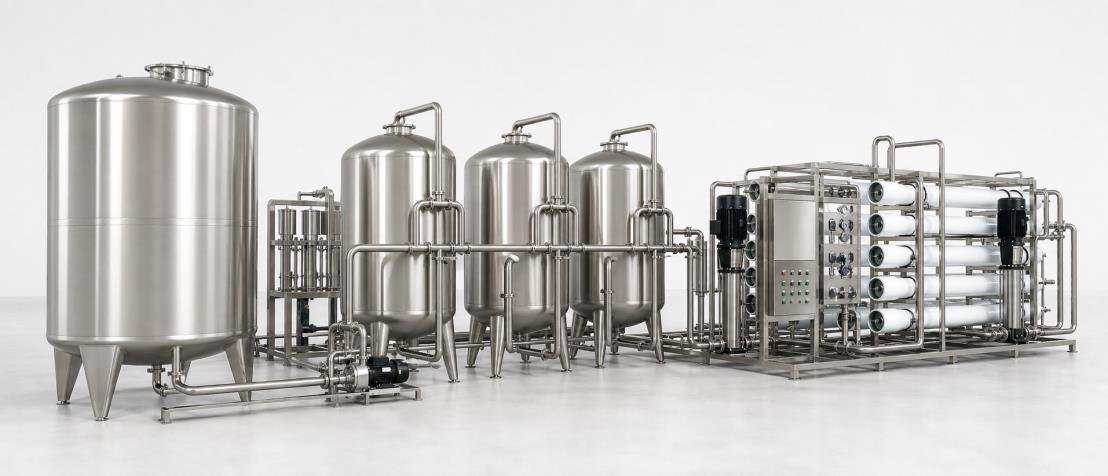
The well pump rating does not prove continuous sustainable yield, and filler demand is rarely constant throughout the day. Create a time-based balance showing permitted and assessed abstraction, pumping schedule, raw-water buffer, treatment net output, product-water storage and filler draw. Consider low-level protection, dry-run response, pump cycling and the condition after an extended stop. A buffer can decouple flows but cannot correct an unsuitable source or create daily volume. Assign the wellhead, pump cable, raw-water pipe, tank, level controls and treatment inlet to named parties so hydraulic and signal interfaces do not disappear between contracts.
System focus 03
Review physical, chemical and microbiological evidence together. Turbidity or suspended solids, iron and manganese state, hardness and scaling tendency, dissolved salts, gases, organic indicators and relevant microorganisms can lead to different treatment routes. The appropriate process may include aeration, oxidation, settling, filtration, adsorption, softening, membranes or a final control step, but no sequence is universal. Ask the designer to state the purpose, inlet assumption, outlet target, monitoring point, chemical or media requirement and residual stream for every stage. Pilot or bench work may be appropriate where treatability is uncertain.
System focus 04
A useful monitoring plan distinguishes source surveillance, process control and finished-product release. Online instruments can track selected indicators such as level, flow, pressure, turbidity, conductivity, pH or disinfectant-related variables where applicable, while laboratory testing covers characteristics that cannot be inferred from those signals. Define instrument locations, calibration, alarm actions, sampling valves and responsibility for review. Trend raw and treated results with pump and treatment operating conditions so a change can be investigated. A clear hold, diversion or stop response is more valuable than collecting data without an assigned decision.
System focus 05
Requirements for source approval, water categories, treatment processes, discharge, sampling and labeling depend on the production and destination jurisdictions. Build a compliance register identifying who confirms each requirement and when evidence is needed. Equipment acceptance can verify installed components, flows, controls, alarms, cleaning functions and water results under declared conditions. It should also hand over operating limits, consumables, residual handling and maintenance instructions. Do not describe a short commissioning sample as long-term legal conformity; ongoing source protection, monitoring, operations and regulatory review remain part of the plant management system.
Borehole treatment design brief
Complete all three groups before treating a proposed flow diagram as a final design.
Document the origin and limits of the water supply.
Give every treatment stage a stated purpose.
Define how operation and acceptance will be judged.
Final source use, treatment permission, product description and discharge obligations require project-specific review in the applicable jurisdictions.
Buyer questions
Use these answers as a project-planning starting point. Final equipment and performance remain subject to the confirmed brief.
No. Treatment depends on representative source evidence, the intended product and local requirements. Reverse osmosis may address certain dissolved constituents, but it adds concentrate, energy, pretreatment and product-composition decisions that should be justified.
Usually it is an incomplete basis. Sampling context, pumping state, source history and likely seasonal or operational variation matter. A competent source and process review should decide the appropriate sampling program before final design.
Storage can bridge a defined difference between abstraction, treatment and filling for a limited time. It cannot increase sustainable daily source yield or solve permission, source-quality or long-term replenishment constraints.
That decision belongs in a jurisdiction-specific regulatory and product review. Equipment suppliers can describe process capability, but they should not determine source eligibility, legal category or label claims for every destination market.
Capacities, process routes, layouts, utilities and equipment shown on this site are decision frameworks and reference examples. They are not a final specification, performance guarantee or offer. Confirmed scope and performance are defined in the signed technical and commercial agreement.
Allot Tech project desk
Share the source water, bottle, target output, pack format, factory status and destination. We will use them as the basis for a project-specific configuration discussion.