Identify the metal form before choosing the removal train
Iron and Manganese Removal for Bottled Water
Iron and manganese results become actionable only when sampling preserves their actual dissolved, colloidal or particulate condition and the proposed treatment is tested against the source-water envelope.
How should iron and manganese removal be designed for bottled-water production?
Confirm total and dissolved iron and manganese with representative source samples, together with pH, alkalinity, oxygen, turbidity, organics and other constituents that influence oxidation and filtration. Determine whether pumping, aeration or sample handling is already changing the metal form. The process designer can then evaluate oxidation, contact, media filtration or another justified route, with bench or pilot evidence when kinetics or media loading are uncertain. Define backwash water, residual disposal, downstream polishing, cleaning and monitoring boundaries. Acceptance should measure feed and treated water under declared flow and operating conditions after appropriate stabilization; a media name or pressure-vessel size alone does not prove removal.
System focus 01
Preserve the source condition in sampling and analysis
Iron and manganese can change state after exposure to air, disinfectant, a storage tank or a long sample-holding time. Record the sampling point, pumping duration, field appearance, temperature, pH and preservation method, then distinguish dissolved and total results where the investigation requires it. Include turbidity, suspended matter, alkalinity, oxygen, organic indicators and other relevant chemistry. Review historical staining, sediment and seasonal behavior without treating appearance as a concentration measurement. If different wells are blended, test both individual sources and the intended blend because oxidation demand and filter loading may change.
Total and dissolved iron and manganese results
Sampling point, pumping state, preservation and holding context
pH, alkalinity, oxygen, turbidity and organic indicators
Seasonal, well-by-well and planned blending variation
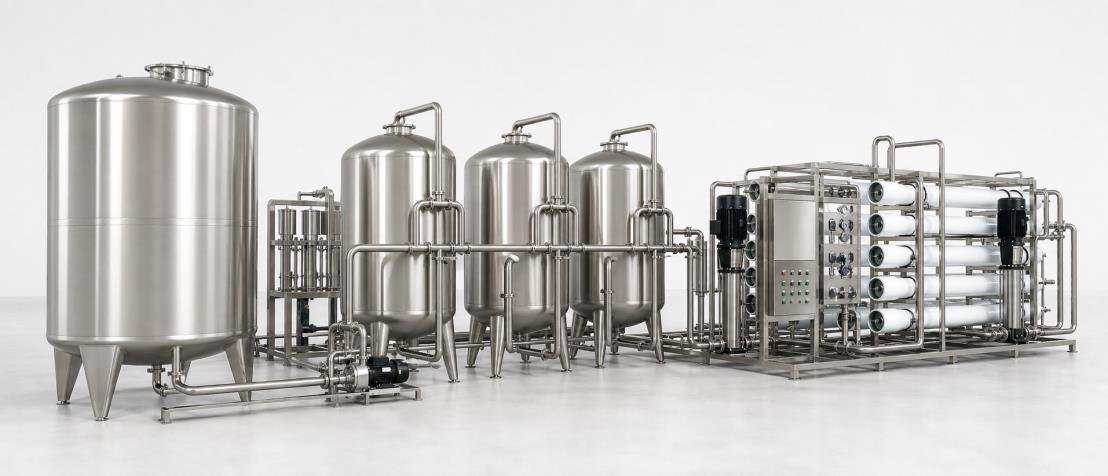
Reference equipment image. The final equipment selection, configuration and safeguards depend on the confirmed project brief.
System focus 02
Select oxidation and contact conditions from treatability
Removal often depends on converting dissolved metals into a filterable form or using a media process with suitable catalytic behavior, but reaction rate changes with pH, temperature, water chemistry, oxidant and contact time. Aeration or chemical oxidation may be considered, yet each option adds different controls and residuals. Ask for the reaction basis, dosing or air-transfer method, mixing, contact volume, target condition and overfeed protection. Where source behavior is uncertain, bench or pilot work can observe oxidation, settling and filtration rather than relying on a generic dose copied from another water.
Proposed oxidation mechanism and supporting water evidence
Mixing, contact time and operating-condition basis
Dose, air transfer, residual and overfeed controls
Bench or pilot trial plan for uncertain kinetics
System focus 03
Engineer filtration around solids loading and breakthrough
Filter selection should state media, bed arrangement, service flow basis, inlet metal condition, expected solids load and the indicator used to end a run. Pressure loss alone may not reveal dissolved breakthrough, while an outlet concentration alone may not show plugging. Provide sampling before and after each relevant stage and enough valve and access detail for inspection, media handling and isolation. If multiple vessels alternate or operate in parallel, describe the control sequence and flow sharing. Any downstream membrane or final treatment should receive a defined inlet condition rather than an assumption that all metals have disappeared.
Media and bed design tied to treatability evidence
Service flow, solids loading and run-end criteria
Differential pressure and stage-by-stage sample points
Parallel, standby, isolation and downstream-protection logic
System focus 04
Include backwash, rinse and residual handling in capacity
Media systems need suitable backwash flow, pressure, water quality and duration, plus a route for dirty water and settled solids. Confirm whether treated or raw water supplies backwash, how storage supports peak demand and what happens to product flow during the cycle. The drainage or residual system must accommodate the hydraulic peak and actual composition after local review. Define rinse-to-waste criteria and the permissive for returning a vessel to service. Backwash frequency should follow measured loading and operating evidence, not an unsupported fixed interval presented as a guaranteed schedule.
Backwash source, peak flow, pressure and storage demand
Dirty-water, settled-solids and chemical residual route
Production response during backwash or vessel isolation
Rinse endpoint and return-to-service authorization
System focus 05
Accept the process with trends, samples and operating records
Agree feed conditions, treatment flow, stabilization, sample points, laboratory methods and instrument accuracy before commissioning. Record oxidant or air condition where used, pH, filter differential pressure, backwash state and metal results so removal can be interpreted. Challenge alarms, low-chemical or air-loss responses, valve sequences and restart after backwash. Handover should include media and chemical specifications, operating ranges, sampling schedule, maintenance tasks and investigation steps for breakthrough. Product release and regulatory conformity require the approved site quality program; equipment acceptance covers the defined process under represented conditions.
Feed range, flow and stabilization period for the test
Traceable field readings and laboratory sample results
Alarm, backwash, rinse and restart sequence challenges
Operating limits, consumables and breakthrough response handover
Iron and manganese treatability path
Move from preserved sample to repeatable removal evidence
The sequence keeps changing metal forms and residual streams visible through design and commissioning.
1. Preserve the source state
Record sampling and pumping conditions and obtain total, dissolved and supporting chemistry on representative water.
2. Test the conversion mechanism
Evaluate oxidation or media behavior, mixing and contact under the expected pH, temperature and competing demand.
3. Size the solids-removal stage
Relate filtration, service run and monitoring to expected precipitate and observed breakthrough behavior.
4. Close the residual balance
Define backwash supply, dirty-water peak, solids route, rinse endpoint and production response.
5. Verify the installed sequence
Record field conditions, laboratory results, valve cycles, alarms, backwash and return to service.
6. Transfer operating ownership
Hand over ranges, sampling, media or chemicals, maintenance and investigation actions for changing source conditions.
Final process selection remains conditional on representative water, treatability evidence, local requirements and the approved residual route.
Buyer questions
Frequently asked questions
Use these answers as a project-planning starting point. Final equipment and performance remain subject to the confirmed brief.
Can a sediment filter remove dissolved iron and manganese?
A particulate filter mainly retains material already in a filterable form. Dissolved metals may need oxidation, catalytic treatment or another justified process before effective removal. Confirm speciation and treatability instead of relying on total concentration alone.
Is aeration always sufficient for iron and manganese removal?
No. Reaction behavior depends on metal form, pH, temperature, oxygen transfer, contact time and other water constituents. Iron and manganese may respond differently. Testing and a complete process review determine whether aeration is suitable.
How is filter backwash capacity included in the plant balance?
List peak backwash flow, duration, source-water quality, storage draw, simultaneous production state and dirty-water route. The treatment and storage schedule should show whether product supply continues, reduces or stops during each cycle.
Does clear treated water prove that iron and manganese are controlled?
No. Dissolved material and very fine particles may not be visible. Use appropriate laboratory methods and process monitoring at defined points, with appearance treated only as an additional operational observation.
Continue planning
Related production-line decisions
Move to the technical decision that depends on the information covered on this page.
Define peak discharge, solids handling and local review ownership.
Project-specific confirmation
Capacities, process routes, layouts, utilities and equipment shown on this site are decision frameworks and reference examples. They are not a final specification, performance guarantee or offer. Confirmed scope and performance are defined in the signed technical and commercial agreement.
Allot Tech project desk
Turn your requirements into a comparable line brief.
Share the source water, bottle, target output, pack format, factory status and destination. We will use them as the basis for a project-specific configuration discussion.