Guideline for Water ReUse in Beverage Production and Food Processing
Industry and research reference used for process-flow and mass-balance planning; any reuse decision still requires site-specific safety and regulatory assessment.
Reconcile every significant water stream by operating mode
Product output is only one branch of plant water use; treatment reject, backwash, rinsing, cleaning and drains must be visible on the same boundary.
Direct answer
Draw a boundary around the plant or selected process and define the time and operating mode. List source-water intake and every material water outlet: bottled product, treatment reject, filter backwash, bottle rinse, CIP or sanitation discharge, floor cleaning, compressor condensate, utility water, tank drains and wastewater. Identify transfers and storage-level changes so the same flow is not counted twice. Assign a meter, calculation or documented estimate to each stream, including uncertainty and data owner. Reconcile inputs, outputs and inventory change for production, startup, cleaning and shutdown separately. Investigate unexplained difference before using the balance for equipment sizing, permits, recovery projects or performance claims.
System focus 01
A mass balance can describe the complete site, water-treatment room, treated-water loop or one production line. State the chosen boundary and draw every stream crossing it. Select a period that matches available meters and stable operating records. Separate production from startup, changeover, cleaning and idle circulation because their water routes differ. Record tank opening and closing levels where stored inventory changes materially. Without these definitions, two correct measurements can still be compared on incompatible bases.
System focus 02
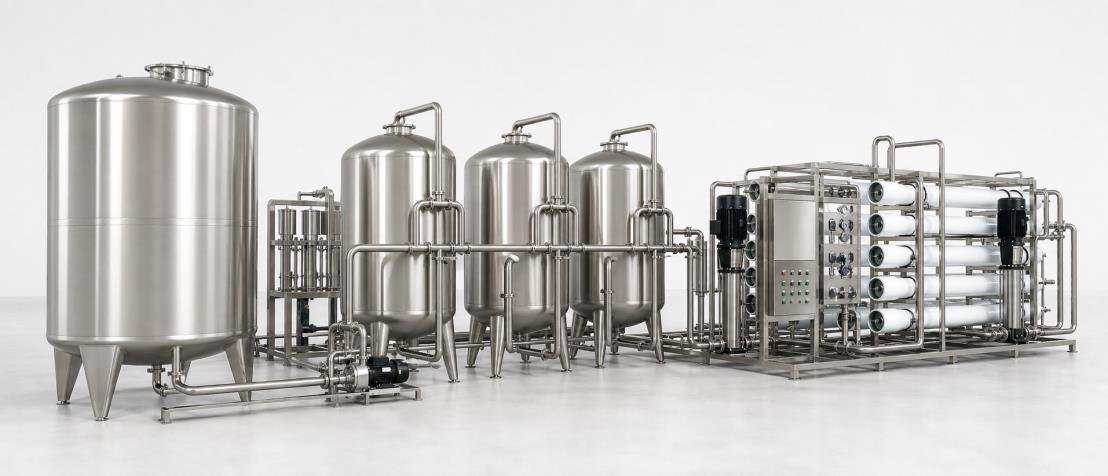
Trace raw water through pretreatment, membrane or other selected processes, disinfection, treated-water storage and filler feed. Show backwash, regeneration, flush, reject and sampling branches rather than drawing only the product arrow. If several sources or product routes exist, keep them identifiable. The page should not assume that every plant uses RO or a particular recovery. Use the actual raw-water analysis, treatment design and validated operating sequence to define which streams exist and when they flow.
System focus 03
The production hall can use water even when no product enters a bottle. Map bottle rinsing, cap treatment where applicable, equipment cleaning, CIP make-up and rinse, chemical preparation, floor cleaning, cooling or vacuum services, compressor condensate and maintenance drains. Distinguish water that contacts product or food-contact surfaces from non-product utilities. Record whether a stream is continuous, batch, event-based or only a potential emergency discharge. This detail helps drainage and treatment planning without implying that streams can be reused.
System focus 04
Use calibrated or otherwise fit-for-purpose meters where a stream affects design, control, cost or compliance. For unmetered batch events, a documented volume and event count may be more transparent than false precision. Record units, totalizer reset, meter range, data interval and owner. Compare input with outputs plus inventory change, then trend the residual. A residual can come from leaks, unrecorded drains, meter error, timing mismatch or incomplete stream mapping; it should not automatically be labelled waste.
System focus 05
A verified balance supports source and drain sizing, storage review, operating diagnosis and prioritization of water-reduction trials. Compare operating modes and normalize only on a clearly defined product or time basis. Before proposing reuse, assess hygienic, chemical, regulatory and cross-connection risks for the actual stream and destination. Validate any change through an approved trial and update the P&ID, procedures and balance. Do not publish universal water-use ratios or savings; bottle route, treatment, cleaning and local requirements materially change them.
Mass-balance register
Reconcile one operating mode at a time before comparing sites, formats or improvement ideas.
| Stream | Operating basis | Measurement method | Decision supported |
|---|---|---|---|
| Source and treatment | Production, flush or backwash state | Meter, totalizer or documented batch | Capacity, recovery and storage review |
| Product and packaging | Format, good units, rejects and fill basis | Reconciled count and volume evidence | Product output and filler-feed balance |
| Cleaning and utilities | Event, step, duration and active users | Meter or controlled volume estimate | Drain, schedule and reduction review |
| Residual | Inputs minus outputs and inventory change | Common-period reconciliation | Mapping, leak or measurement investigation |
Do not use an unreconciled balance to state water savings, size final infrastructure or approve reuse.
Editable buyer worksheet
Reconcile product water, treatment reject, rinse, cleaning, backwash, drains, reuse and unmetered differences on one operating basis.
Technical reading
Confirm the standards, guidance and legal requirements that apply to the project location and product before final design.
Industry and research reference used for process-flow and mass-balance planning; any reuse decision still requires site-specific safety and regulatory assessment.
International primary reference for separation, hygienic processing and packaged-water controls used to bound water-stream decisions.
Primary reference for confidence in measurement results; it does not prescribe meters or acceptable balance residuals for this plant.
Buyer questions
Use these answers as a project-planning starting point. Final equipment and performance remain subject to the confirmed brief.
No. RO recovery describes a membrane-system relationship on a defined basis. The plant balance also includes source intake, storage change, product, backwash, rinsing, cleaning, utilities, drains and unexplained difference.
Use a reconciled method appropriate to the decision. Bottle count times verified fill can support one estimate; a suitable flow or tank measurement provides another. Record rejects, partial containers, timing and measurement uncertainty.
No. Reuse depends on its quality, variability, proposed destination, cross-connection controls, hygienic risk and local requirements. It requires project-specific assessment and approval, not only a favorable mass balance.
It may reflect an omitted stream, timing mismatch, storage change, leak, unrecorded drain or measurement error. Investigate the mapping and evidence before treating the residual as a physical loss.
Capacities, process routes, layouts, utilities and equipment shown on this site are decision frameworks and reference examples. They are not a final specification, performance guarantee or offer. Confirmed scope and performance are defined in the signed technical and commercial agreement.
Allot Tech project desk
Share the source water, bottle, target output, pack format, factory status and destination. We will use them as the basis for a project-specific configuration discussion.