WHO Guidelines for Drinking-water Quality, fourth edition with addenda
International risk-management framework for drinking-water quality; local authorities set and enforce applicable requirements.
Source-to-factory setup guide for project owners
Set up the plant as one coordinated business, product, factory and production project—not as a collection of machines purchased before the operating basis is known.
Direct answer
Set up a bottled water production plant by confirming the target market and product, securing and testing the intended water source, defining bottle formats and saleable output, establishing destination-specific regulatory responsibilities, selecting a complete treatment-to-pack equipment scope, preparing the building and utilities, and agreeing how installation, commissioning, training and acceptance will be completed. A useful plan assigns an owner, evidence and completion condition to every workstream before equipment is ordered.
System focus 01
Begin with the customers, pack formats, selling channels and production scenarios the plant is expected to serve. Define whether the product is purified, spring, natural mineral or another locally recognized category only after the source and destination requirements are reviewed. Translate sales forecasts into reference bottles per hour, shifts, operating days, format mix and finished-pack patterns. This prevents a machine speed from becoming the business plan and makes later equipment quotations comparable.
System focus 02
Identify the actual source, collection conditions, available flow, ownership or supply rights and representative chemical and microbiological evidence. Then appoint qualified local specialists to determine permits, product classification, source protection, treatment restrictions, food-facility duties, testing, labeling, records and environmental responsibilities for the destination. International guidance can inform the risk-management approach, but it does not replace the rules enforced where the plant and product will operate.
System focus 03
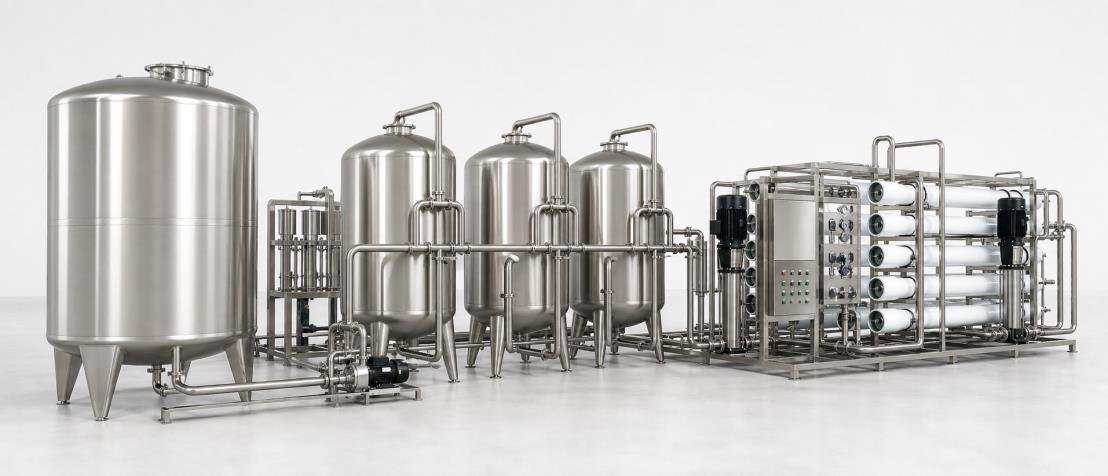
Map the two upstream streams before choosing machines. Water moves through project-specific treatment, disinfection, hygienic storage and controlled filler feed. Containers arrive as preforms for onsite blowing or as purchased empty bottles. These streams meet at rinsing, filling and capping, then continue through inspection, labeling, coding, packing and finished-pack handling. Add the compressors, air treatment, receivers, cooling, tanks, pumps, conveyors, controls, cleaning provisions, change parts and spares required to operate the selected architecture.
System focus 04
Develop a scaled layout that separates incompatible movements and provides practical access for people, materials, maintenance, cleaning, testing and finished goods. Confirm floor condition, clear height, columns, doors, unloading and lifting routes. Build the utility schedule from the selected equipment rather than generic ratios: voltage and frequency, high- and low-pressure air, cooling, process and cleaning water, drainage, ventilation and any heat rejection all need normal, peak, quality and connection-point definitions.
System focus 05
Freeze the technical basis and responsibility matrix before procurement and manufacturing progress too far. Approve layouts, interfaces, documentation and test protocols against named materials and measurements. Prepare the factory in parallel with manufacturing, then verify readiness before shipment or site mobilization. Commission from utilities and individual machines toward connected dry and product runs. Complete training, manuals, backups, spare parts, acceptance records and open-item ownership before routine production is treated as handed over.
Plant setup gates
Do not release the next investment decision while a critical input, responsibility or acceptance condition remains hidden.
Record the intended products, packs, channels, demand cases, operating schedule and decision owner.
Collect water evidence and assign local product, facility, permit, testing, labeling and environmental review.
Name the bottle, closure, label, pack, saleable output and other required formats.
List process equipment, bottle route, filling, end of line, auxiliaries, controls, documents and services.
Approve layout, access, utilities, drainage, hygiene, material flow and buyer-side work.
Close agreed drawings and FAT evidence while confirming the building, services, materials and lifting plan.
Progress through individual and integrated tests, training, documentation, spares and recorded open-item closure.
This workflow supports project planning. Final engineering, legal, regulatory and financial decisions require qualified project-specific review.
Technical reading
Confirm the standards, guidance and legal requirements that apply to the project location and product before final design.
International risk-management framework for drinking-water quality; local authorities set and enforce applicable requirements.
Primary US overview of sanitary production, source protection, quality controls and testing responsibilities.
Primary EU overview of product categories, recognition and treatment constraints for natural mineral and spring waters.
Buyer questions
Use these answers as a project-planning starting point. Final equipment and performance remain subject to the confirmed brief.
There is no responsible universal total. Equipment is only one budget layer. Water-source work, building, utilities, laboratory and compliance needs, packaging materials, logistics, installation, staffing, distribution and working capital can materially change the plant investment. Build low, base and expansion scenarios using local quotations and one confirmed production basis.
The usual functional scope covers water treatment and storage, bottle blowing or empty-bottle handling, rinsing/filling/capping, conveyors and inspection, labeling and coding, secondary packing, plus required air, cooling, pumping, controls and sanitation provisions. The exact equipment train depends on the water, bottle, output, pack and factory boundary.
A reliable area cannot be selected from bottles per hour alone. It depends on the equipment configuration, bottle route, storage policy, pack and pallet flow, quality and utility rooms, access, maintenance clearance, sanitation zoning and future expansion. Use approved equipment footprints and a scaled material-flow layout.
Duration depends on permits, water-source evidence, information quality, scope, design approvals, equipment manufacture, building and utility readiness, shipping, installation, corrective work and acceptance. Use a dependency-based project schedule with named gates rather than a generic promised number of months.
Deep technical guides
Each guide answers one narrower project question and links the result back to complete-line scope.
A useful water bottling plant layout coordinates production flow, hygiene, utilities, access, maintenance, storage and dispatch. It cannot be selected from bottles per hour or one generic floor-area number.
A small bottled water production line should be sized around realistic saleable demand and operating capability. “Small” does not mean that treatment, hygiene, utilities, packing or acceptance can be omitted.
A production-line schedule is credible when it links information, engineering, manufacturing, factory preparation and acceptance through named gates and responsible owners.
A structured checklist exposes missing inputs early, keeps supplier assumptions visible and gives technical and commercial teams one project basis to review.
A bottled water plant feasibility study should test whether a defined market, compliant product, sustainable water source, realistic factory and executable operating model can work together. It should compare capacity scenarios and identify evidence still needed before equipment selection.
Capacities, process routes, layouts, utilities and equipment shown on this site are decision frameworks and reference examples. They are not a final specification, performance guarantee or offer. Confirmed scope and performance are defined in the signed technical and commercial agreement.
Allot Tech project desk
Share the source water, bottle, target output, pack format, factory status and destination. We will use them as the basis for a project-specific configuration discussion.