Right-size the first line without creating a dead end
Small Bottled Water Production Line: Practical Buyer Guide
A small bottled water production line should be sized around realistic saleable demand and operating capability. “Small” does not mean that treatment, hygiene, utilities, packing or acceptance can be omitted.
How should a buyer choose a small bottled water production line?
Choose a small bottled water production line by defining the intended water product, reference bottle and pack, realistic daily saleable demand, shifts, labor, factory services, bottle supply route and growth scenario. Then compare a semi-automatic, compact automatic or broader integrated scope on the same complete-project boundary. Confirm water treatment, bottle preparation or supply, rinsing/filling/capping, inspection, labeling, coding, packing, utilities, spares, installation and acceptance responsibilities. The right first line is the system the team can operate and support while preserving defined expansion interfaces.
System focus 01
Define small from saleable demand rather than a marketing label
Start with monthly and daily demand scenarios by bottle and pack, then translate them into required good output within realistic operating hours. Allow for sanitation, material replenishment, changeovers, planned maintenance and normal operating loss without treating one machine nameplate as guaranteed daily production. A modest reference output may fit an early market, but the factory also needs storage, distribution and working-capital plans that can absorb the intended production volume.
Demand by bottle, pack and sales channel
Good output required per day and shift
Operating days and available production hours
Cleaning, changeover and maintenance allowance
Finished-goods storage and distribution capacity
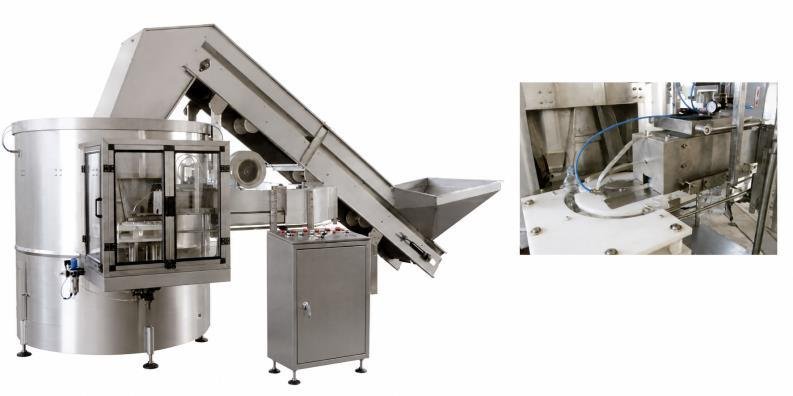
Reference equipment image. The final equipment selection, configuration and safeguards depend on the confirmed project brief.
System focus 02
Keep the minimum complete production architecture visible
Even a compact project needs suitable product water, clean acceptable bottles, closures, controlled filling, identification and a stable finished pack. Decide whether the project starts from raw water or treated water and whether it blows PET bottles onsite or receives empty bottles. List tanks, pumps, conveyors, air, cooling, inspection, code, label, pack and cleaning provisions with the main machines. Omitting an auxiliary from a quotation does not remove it from the production requirement.
Water-treatment and hygienic-storage boundary
Onsite blowing or purchased-bottle infeed
Rinsing, filling, capping and inspection
Label, code and secondary-pack route
Required utilities, controls and sanitation provisions
System focus 03
Compare automation with labor, skill and product control
Lower automation can reduce the supplied machine scope but may increase repetitive handling, operator dependence, floor activity and production variability. More automatic transfer can reduce manual touches while adding controls, sensors, maintenance needs and capital. Map who loads bottles, caps, labels and packing materials; who moves finished packs; and how defects are detected. Select the automation boundary the available team can run, clean, maintain and troubleshoot safely.
Manual loading and unloading tasks
Operator count and working positions
Container and product-contact handling
Control, sensor and maintenance capability
Inspection, reject and production-record method
System focus 04
Budget the factory and startup, not only the filling machine
A small-line budget should separate core machines, required auxiliaries, site distribution, building work, freight, installation, test materials, training, spares, packaging inventory and working capital. Verify voltage, frequency, water supply, high- or low-pressure air, cooling, drainage, ventilation and access. Local prices and responsibilities determine the investment, so compare scenarios and confirmed quotations rather than relying on a universal online price range.
Core equipment and required auxiliaries
Building, floor, drains and utility distribution
Packing, freight and delivery boundary
Installation, commissioning and training
Startup materials, spares and working capital
System focus 05
Design expansion interfaces before the first order
Growth is easier when the first layout, power distribution, air system, water treatment, controls and conveyor direction preserve named future connections. Identify which equipment may remain, which may become a backup and which would restrict a larger line. Avoid buying oversized machines without a realistic bottle and pack balance, because prolonged low-load operation can still create cost and control problems. Test the first line on the actual reference materials and retain drawings, settings, backups and open-item records for future integration.
Low, base and expansion demand cases
Retained, replaced and future equipment map
Reserved floor and utility capacity
Named mechanical and control interfaces
Acceptance records and configuration backups
First-line architecture
Compare three startup routes on one complete boundary
The labels below describe planning directions, not fixed packages. Each quotation still needs project-specific scope and evidence.
Decision factor
Lower-automation route
Compact automatic route
Expansion-ready coordinated route
Best question
Can trained labor perform defined handling safely and consistently?
Can a compact connected line match the main reference product?
Which first-stage systems should remain useful as demand grows?
Bottle supply
Often purchased bottles or separate preparation
Purchased bottles or matched compact blower
Defined onsite or purchased-bottle architecture with future interfaces
Handling
More manual loading, transfer and packing
Automatic core transfers with selected manual tasks
Coordinated transfer, accumulation and downstream expansion points
Utilities
Lower connected load may still need full-quality services
Confirm actual peak loads and auxiliary scope
Reserve agreed distribution and connection capacity
Staff capability
Relies on disciplined operator methods
Adds controls and maintenance requirements
Needs line-level production and engineering ownership
Acceptance
Test manual and machine responsibilities together
Test reference product through the connected scope
Record performance and interfaces for later integration
Main risk
Hidden labor, handling and consistency cost
Assuming compact means every auxiliary is included
Paying for unused speed without a balanced growth plan
Use local quotations and operating assumptions. No route is universally lowest cost or best for every startup.
Buyer questions
Frequently asked questions
Use these answers as a project-planning starting point. Final equipment and performance remain subject to the confirmed brief.
What capacity counts as a small bottled water line?
There is no universal threshold. Use the reference bottle, required good output, available hours, pack route, labor and market scenario. A capacity label without those conditions is not a project definition.
Is a semi-automatic line always cheaper for a startup?
Not necessarily over the complete operating scenario. Compare equipment, labor, handling, floor space, production consistency, maintenance, rejects and expansion work using local values.
Should a small plant blow PET bottles onsite?
It depends on preform and bottle supply, freight, storage, power, high-pressure air, cooling, technical skill and forecast utilization. Purchased bottles and onsite blowing should be modeled as separate complete routes.
Can a small line be expanded later?
Yes, when the initial equipment, layout, utilities, controls and bottle route include defined future interfaces. Expansion still requires a new line-balance and compatibility review.
Continue planning
Related production-line decisions
Move to the technical decision that depends on the information covered on this page.
A PET bottled water line succeeds when bottle formation or supply, treated-water delivery and downstream packaging are engineered around one reference product and one operating basis.
The right production line is the system that fits the confirmed product, container, operating plan and factory boundary, not simply the machine with the largest nameplate rate.
Preforms and empty bottles place cost, space, quality control and operating responsibility in different parts of the supply chain, so the better route depends on local project conditions.
A structured checklist exposes missing inputs early, keeps supplier assumptions visible and gives technical and commercial teams one project basis to review.
Project-specific confirmation
Capacities, process routes, layouts, utilities and equipment shown on this site are decision frameworks and reference examples. They are not a final specification, performance guarantee or offer. Confirmed scope and performance are defined in the signed technical and commercial agreement.
Allot Tech project desk
Turn your requirements into a comparable line brief.
Share the source water, bottle, target output, pack format, factory status and destination. We will use them as the basis for a project-specific configuration discussion.