Container and product
Define what enters the monoblock.
- Bottle drawing and samples
- Neck and closure specification
- Product-water conditions
- Required formats and outputs
XGF product model reference
Use the verified XGF60-60-15 specification as a starting point, then confirm the bottle, product water, closure, connected equipment and complete-line acceptance basis.
Direct answer
The XGF60-60-15 is an XGF rinsing, normal-pressure filling and capping monoblock with a published reference output of 30,000 bottles per hour for 500 ml bottles. Its station configuration is 60 rinsing / 60 filling / 15 capping positions. The catalog lists a machine size of 5,770 × 5,288 × 2,700 mm, a reference weight of 10,800 kg and installed power of 11.00 kW. These values describe the filling platform, not guaranteed saleable output for a connected production line.
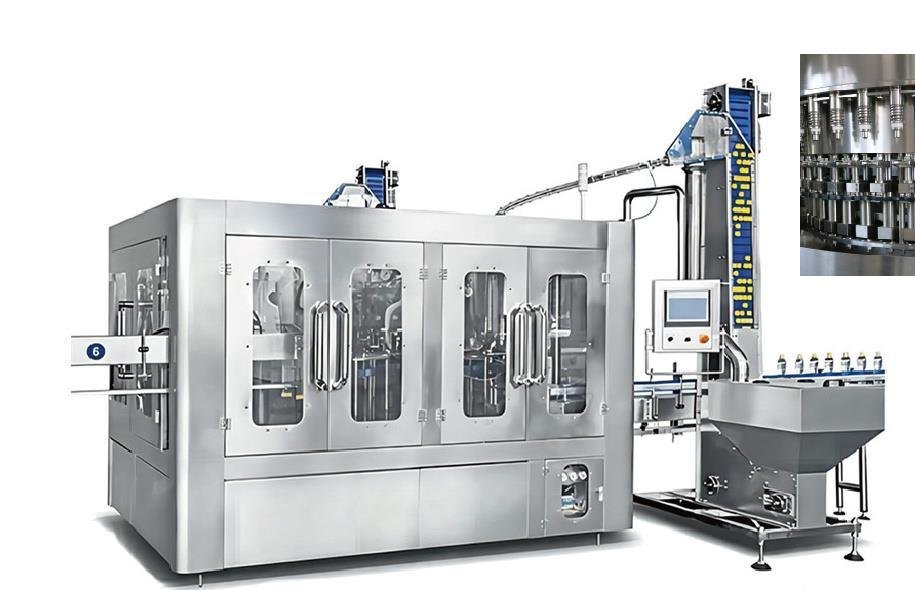
Reference XGF filling equipment image. Final arrangement, materials, components, guarding and options are confirmed for the actual order.
Verified catalog specification
Reference qualification: these figures describe the published filling platform. Complete-line saleable output, final model configuration, current availability and commercial scope require a project-specific written quotation.
System focus 01
This 30,000 BPH reference increases the rinsing and filling positions to 60 while retaining 15 capping heads, so downstream pack-rate confirmation becomes especially important. Compare it directly with XGF50-50-15 and XGF72-72-18 before fixing the output class.
System focus 02
The 30,000 BPH value is meaningful only on the catalog reference basis. A larger or less stable bottle, different neck and cap, product-water conditions or frequent format changes can alter the usable rate and the required connected equipment.
System focus 03
A filling monoblock cannot sustain output when treated-water delivery, air-conveyor bottle supply or closure handling is unstable. Define these three infeed conditions around the XGF60-60-15 rather than treating them as separate purchases.
System focus 04
Sealed bottles leaving the XGF60-60-15 need inspection, controlled conveying, useful accumulation, labeling, coding and secondary packing on the same bottle and pack basis. A filler rating alone does not define saleable line output.
System focus 05
The final proposal should identify the exact machine configuration, materials, bought-out components, guarding, controls, change parts, documentation, services and test conditions. Reference specifications do not replace the signed technical agreement.
XGF60-60-15 selection brief
A model name and nominal BPH are not enough to freeze the filling center or the connected line.
Define what enters the monoblock.
Define what must sustain it.
Define what the order must prove.
The catalog figures are qualified references. Current configuration, availability, output and commercial scope require a project-specific written quotation.
Buyer questions
Use these answers as a project-planning starting point. Final equipment and performance remain subject to the confirmed brief.
No. 30,000 BPH is the published filler-platform reference for 500 ml bottles. Saleable complete-line output depends on treatment, bottle supply, closure handling, utilities, downstream equipment, changeovers, rejects and the agreed measurement method.
Provide the bottle volume, dimensioned drawing, neck finish, cap, physical samples when available, required rate for each format and the expected number of changeovers.
It can be discussed as a filling-center scope, but every quotation still needs the treated-water, bottle infeed, closure, discharge, controls and utility boundaries that connect it to the rest of the plant.
Compare it directly with XGF50-50-15 and XGF72-72-18 before fixing the output class. Compare all candidates on the same bottle, capacity, utility, component, documentation and acceptance basis rather than model name alone.
Allot Tech project desk
Share the source water, bottle, target output, pack format, factory status and destination. We will use them as the basis for a project-specific configuration discussion.