Rockwell Automation beverage manufacturing overview
Primary automation-industry reference used for the general role of integrated controls and production information; it does not define this project architecture.
Define control ownership before selecting controller brands
A complete bottled-water line needs coordinated machine states, recoverable controls and usable operating evidence, not only a list of PLC and HMI brands.
Direct answer
Specify the control system from the operating sequence and responsibility boundaries. Name the line coordinator, define ready, running, starved, blocked and fault handshakes for every machine, and state where speed references, recipes, alarms, production counts and reject records are owned. Include user access, backup and restore, remote-support rules, network interfaces and document handover. Acceptance should exercise normal production states, stops, recovery, failed signals and approved format changes with representative equipment connected. A preferred PLC brand can support maintainability, but it does not replace a complete functional and interface specification.
System focus 01
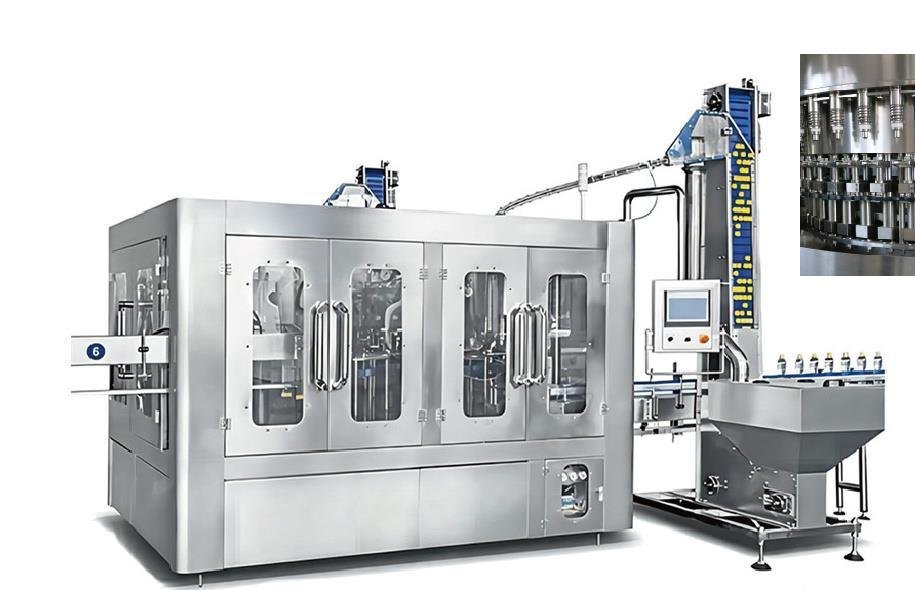
List each independently controlled system from treatment and bottle preparation through filling, inspection and packing. Identify which controller owns local motion, which system coordinates the line, and which signals cross each boundary. The architecture should remain understandable when machines come from different manufacturing resources. A controlled network drawing and interface register help prevent duplicated commands, missing permissives and unsupported assumptions during integration.
System focus 02
A line can contain individually functional machines that still stop repeatedly because upstream and downstream states are ambiguous. Define commands and status signals for availability, run request, speed reference, starvation, blockage, controlled stop and fault. State the timeout and recovery behavior for every exchange. The same state model should be represented in the control narrative, PLC code, HMI diagnostics and integrated test protocol.
System focus 03
Format settings should be versioned and linked to the approved bottle, cap, label and pack rather than stored as unexplained numbers. Alarm messages need a condition, likely location, permitted operator response and reset rule. User roles should separate routine operation, maintenance, engineering changes and administration. Record how changes are authorized and how a known-good configuration is restored after component replacement or software service.
System focus 04
Decide which counts and events the line must retain before requesting dashboards. Define the good-product counting point, reject categories, downtime reason ownership and time basis so reported performance can be reconciled with physical output. If SCADA, MES or remote reporting is required, state protocols, tags, update rates, retention and cybersecurity responsibilities. A local HMI trend and an enterprise reporting system are different scopes and should be described separately.
System focus 05
An automation FAT should demonstrate more than automatic running. Build tests for missing bottles or caps, blocked discharge, utility loss, failed instruments, communications interruption, guard opening and power recovery where those conditions can be tested safely. Record expected and observed responses, open items and the responsible corrective party. Handover should include controlled software, parameter backups, network drawings, alarm lists, licenses and a restore demonstration.
Controls requirement matrix
Use one matrix for machine builders, the line integrator and the plant team before software interfaces are frozen.
| Decision area | Input to confirm | Supplier deliverable | Acceptance evidence |
|---|---|---|---|
| Architecture | Machines, owners, networks and reporting scope | Controlled architecture and interface register | Approved drawings and connected-node check |
| Machine states | Operating and exception scenarios | Handshake and recovery narrative | Integrated state-transition test |
| Data and recipes | Formats, counts, alarms and retention | Tag, recipe and alarm register | Traceable sample records and restore test |
| Handover | Access, licenses and support boundaries | Source files, backups and manuals | File inventory and witnessed recovery |
Final controls, network and safety requirements must be confirmed for the selected equipment, plant standards and destination requirements.
Technical reading
Confirm the standards, guidance and legal requirements that apply to the project location and product before final design.
Primary automation-industry reference used for the general role of integrated controls and production information; it does not define this project architecture.
Technical reference used to compare machine-module control, line coordination, product tracking and safety boundaries without copying implementation code.
Buyer questions
Use these answers as a project-planning starting point. Final equipment and performance remain subject to the confirmed brief.
No. The brand affects support and standardization, but the project still needs a control architecture, machine-state definitions, network interfaces, recipes, alarms, access rules, backups, documentation and acceptance tests.
Not necessarily. Machines can retain local controllers while a line coordinator exchanges defined states and speed references. The suitable architecture depends on scope, supplier boundaries, safety design, support capability and reporting needs.
The agreed handover may include source and compiled programs, HMI project files, parameter and recipe backups, network configuration, software versions, licenses, alarm lists and restore instructions. File ownership and access should be settled in the contract.
Only when counting points, operating windows, machine states, reject categories and downtime reasons are consistently defined. Unqualified counters from separate machines can produce conflicting results.
Deep technical guides
Each guide answers one narrower project question and links the result back to complete-line scope.
Backup power for a bottling line should preserve defined safe, data and recovery functions rather than attempt to run every load without justification. UPS, generator and stored-energy roles must be separated by duration, transfer behavior and restart priority.
Electrical and I/O checkout proves that installed field devices, motors, safety circuits and software addresses correspond to the approved design before integrated operation. It should verify the complete signal path and fail state, not only HMI indication.
Capacities, process routes, layouts, utilities and equipment shown on this site are decision frameworks and reference examples. They are not a final specification, performance guarantee or offer. Confirmed scope and performance are defined in the signed technical and commercial agreement.
Allot Tech project desk
Share the source water, bottle, target output, pack format, factory status and destination. We will use them as the basis for a project-specific configuration discussion.